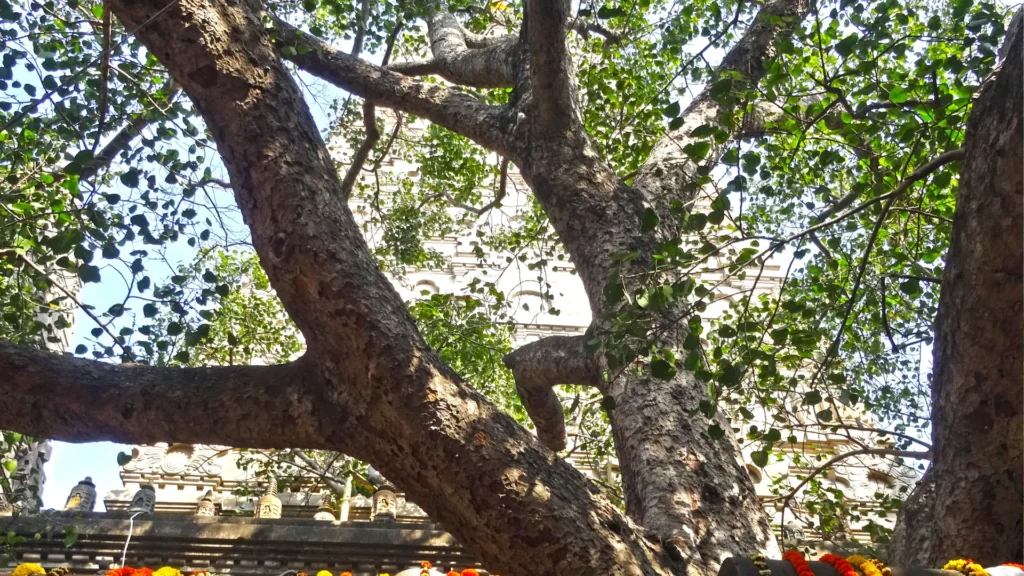
The Sacred Bodhi Tree at Bodh Gaya: 7 Incredible Facts That Will Transform Every Buddhist Who Visits
Some journeys take you to a place. Others take you to yourself. The journey to the Sacred Bodhi Tree in Bodh Gaya, India, is both.
On the surface, you travel to a small town in the state of Bihar through crowded airports, dusty roads, and the gentle chaos of northern India. You arrive at a walled temple complex, remove your shoes, and walk across ancient stone toward a tree that has stood for centuries in the humid, holy air.
But somewhere between that first step on the cool stone and the moment you find yourself sitting beneath the branches of the Ficus religiosa, the Sacred Fig, the Bodhi Tree, something shifts. Something that is hard to name and even harder to forget.
This is the place where Siddhartha Gautama became the Buddha. Where a human being, exhausted by years of seeking, finally stopped and, in stopping, found everything he had been looking for. It is one of the holiest sites in the Buddhist world and one of the most quietly transformative places on Earth.
These are 7 incredible facts about the Sacred Bodhi Tree. Each one is true. And each one, if you let it, will change how you see the act of pilgrimage and perhaps how you see yourself.
Fact 1: The Tree Teaches Its First Lesson Before You Even Arrive
You come to Bodh Gaya to visit the tree. But the tree has already begun teaching you long before you get there.
The journey to Bodh Gaya is not easy. It requires intention. It requires planning, travel, patience, and the willingness to leave the comfort of your ordinary life. Many pilgrims travel from Thailand, Sri Lanka, Japan, or Nepal, crossing time zones, changing planes, and navigating unfamiliar roads.
And in every one of those inconveniences, the pilgrimage has already begun.
The Buddhist tradition teaches that the path itself is the practice. That the effort to reach a sacred place — the inconvenience, the fatigue, the disorientation — is not an obstacle to the spiritual experience. It is the spiritual experience. It loosens your grip on comfort. It quiets the noise of routine. It makes you, by the time you arrive, genuinely ready to receive.
The Buddha himself walked hundreds of kilometers through the plains of India before he reached Bodh Gaya. He arrived having tried everything else: luxury, extreme asceticism, and years of instruction under great teachers. He came to the Bodhi Tree empty of answers and full of willingness.
That is the first lesson. You don’t need to have everything figured out before you arrive. You only need to come.
Fact 2: The Tree Is a Descendant and That Is the Whole Point
Here is a fact that surprises many pilgrims: the tree standing at Bodh Gaya today is not the original tree that sheltered the Buddha.
The original tree was cut down, poisoned, flooded, and worn away over the centuries. But before it was lost, a cutting was saved. Emperor Ashoka’s daughter, Sanghamitta Theri, carried a branch from the Bodhi Tree to Sri Lanka in the 3rd century BCE. That tree still lives in Anuradhapura today. From it, a cutting was returned to Bodh Gaya.
The tree you sit beneath is a direct biological descendant of the original. Not a replacement. A continuation.
And here is why that matters: this is precisely how the Dhamma survives.
The Buddha’s teachings were not preserved in a single scroll locked in a vault. They were passed from teacher to student, generation to generation, monastery to monastery, country to country. They arrived in Thailand, Myanmar, Sri Lanka, and Japan not as perfect copies but as living transmissions, shaped by each culture and each era, yet carrying the same essential seed.
The Bodhi Tree is a living metaphor for this truth. What matters is not that something was preserved perfectly unchanged. What matters is that the lineage was never broken.
You are part of that lineage. Your pilgrimage is one more link in the chain.
Fact 3: Sitting Beneath the Tree Is a Meditation on Failure and Its Gift
Before he became the Buddha, Siddhartha had failed.
He had failed as a prince who thought wealth could solve suffering. He had failed as an ascetic who thought starvation could unlock wisdom. He had failed under the instruction of two of the greatest meditation teachers of his era. He had followed every path available to him, and none of them had delivered what he was seeking.
When he sat down beneath the Bodhi Tree on that famous night, he was, in one sense, a man who had run out of options.
And that the texts suggest is exactly what made him ready.
One of the most powerful experiences many pilgrims report after sitting beneath the Bodhi Tree is a feeling of permission. Permission has been given. Permission to have tried and failed. Permission to not yet be the person they wish they were.
The tree does not sit in judgment. It has no opinion about how many times you have fallen, how far you have wandered, or how long it has taken you to arrive. It simply stands, offering shade, offering silence, and offering the memory that it is possible, even for a human being, to wake up.
🌿 Pilgrim’s Practice: Bring a small notebook. After you have sat quietly for a while beneath the Bodhi Tree, write down one thing you are ready to let go of. Not for anyone else to see, just for you. It is a small thing. And it is not a small thing at all.
Fact 4: The Vajrasana, the Diamond Throne, marks the Exact Spot of transformation.
Directly beneath the Sacred Bodhi Tree is a stone platform called the Vajrasana—the Diamond Throne.
This is said to be the precise spot where Siddhartha sat on the night of his enlightenment. Not approximately. Not symbolically. Here.
It was given its name—Vajrasana, the diamond seat—because diamond is the hardest substance in the natural world. They cannot be cut or broken. And the Buddha’s resolve on that night, the texts tell us, was exactly that quality: unbreakable. Immovable. Completely, perfectly still.
What strikes many pilgrims about the Vajrasana is not its grandeur. It is actually a relatively modest stone, draped in gold cloth and surrounded by offerings of flowers and butter lamps. What strikes people is its ordinariness.
A man sat here. A human being. Not a god, not a supernatural being—a person, not entirely unlike you or me, who made a decision to sit still until he understood the nature of suffering and found the way through it.
That ordinariness is the most extraordinary thing about the Vajrasana. It says, “This is what a human being can do.”
Fact 5: The Tree Has Seven Weeks of Stories — Most Pilgrims Only Know One
Most visitors to Bodh Gaya spend an hour or two at the Mahabodhi Temple and then move on. Most know one story: the night of enlightenment beneath the Bodhi Tree.
But the texts tell us the Buddha spent seven full weeks at Bodh Gaya after his awakening—and each week has its own remarkable story.
In the first week, he stood and gazed at the Bodhi Tree without blinking for seven days, out of pure gratitude for its shelter.
In the third week, he walked in meditation along a path. Lotus flowers bloomed beneath his feet. The stone lotus carvings that mark this path today—the Chankramana—are among the most quietly moving sites in the complex.
In the fifth week, Mara sent three beautiful daughters to distract him. The Buddha looked at them and saw not objects of desire, but impermanent beings struggling with the same fears and longings as everyone else. His compassion transformed what Mara meant as temptation into a moment of teaching.
In the sixth week, a terrible storm arose. The serpent king Muchalinda rose from a nearby lake, coiled around the Buddha seven times, and spread his great hood to protect him from the rain. It is an image that appears across Buddhist art throughout Asia — nature itself bending in reverence.
Each of these seven weeks is a teaching. Each of the seven sacred spots at Bodh Gaya is a chapter in a story about what it looks like to be genuinely, fully awake. A skilled pilgrimage guide makes all the difference—bringing these stories alive so that what you are walking through is not just a temple complex but a living text.
Fact 6: Every Tradition in the Buddhist World Comes Home Here
Buddhism spread from Bodh Gaya across all of Asia, and in every country it reached, it took on a new color, a new form, and a new language. The Theravada of Thailand and Sri Lanka. The Mahayana of Japan and China. The Vajrayana of Tibet. The Zen of Korea.
Each tradition looks a little different. But they all trace the same root—back to this tree, in this town, on that night.
When you visit Bodh Gaya, you see all of them gathered in one place. Thai monks in orange robes, Tibetan lamas spinning prayer wheels, Sri Lankan nuns in white, Japanese practitioners chanting in perfectly still rows, Bhutanese pilgrims prostrating on the stone courtyard.
For many pilgrims, this is one of the most moving experiences of the entire journey. You arrive as a practitioner of one tradition, and you discover, standing in the courtyard of the Mahabodhi Temple, that the family is far larger than you knew.
There is a particular quality of belonging that comes from being in a place where the entire world has gathered to honor the same teacher. It is humbling. It is expanding. It is, in a quiet way, a taste of what the Dhamma itself points toward: the recognition that underneath all our differences, we share the same heart.
Fact 7: You Will Not Leave the Same Person Who Arrived
This is the fact that cannot be proven in advance. It must be experienced.
Many pilgrims who walk the Buddhist Circuit—from Lumbini in Nepal through Bodh Gaya and Sarnath to Kushinagar—describe arriving at the Bodhi Tree as a kind of summit. Not the end of the journey, but its center of gravity. The place that gives meaning to everything else.
Something happens beneath that tree. It is not the same for everyone. Some people weep. Some feel a stillness they have never felt before. Some feel, for the first time, genuinely present in their own lives. Some feel nothing unusual at all in the moment—and then find, weeks later, that something has quietly reorganized itself inside them.
The Bodhi Tree does not promise an experience. It does not manufacture a feeling. It simply stands in the place where the most significant event in the history of human consciousness occurred and offers its shade to anyone who comes.
You bring your life with you when you sit beneath it. Your grief, your questions, your hope, your confusion, your gratitude. The tree holds all of it, without judgment, in the same silence it has held for centuries.
And when you rise and walk away—perhaps you will carry a leaf, or a memory, or simply a quality of quietness that was not in you before.
That is the pilgrimage. That is the Bodhi Tree. That is the beginning of the yatra. with government approval tour operator.
Frequently Asked Questions
Q: What does “Buddha Yatra” mean, and why is Bodh Gaya the heart of it? A: Yatra is a Sanskrit word meaning sacred journey or pilgrimage. A Buddha Yatra is a pilgrimage in the footsteps of the Buddha—visiting the sites of his birth (Lumbini), enlightenment (Bodh Gaya), first teaching (Sarnath), and passing (Kushinagar). Bodh Gaya is the heart of the circuit because it is where the Buddha’s life as a teacher truly began—where an ordinary human being became the Awakened One.
Q: Do I need to be an experienced meditator to benefit from visiting the Bodhi Tree? A: Not at all. The Bodhi Tree is open to everyone — beginners, long-time practitioners, and even the simply curious. Many pilgrims describe their first visit as the beginning of their practice, not a continuation of it. You need no special preparation — only an open heart and a willingness to sit quietly for a while.
Q: How long should I plan to spend at Bodh Gaya on a pilgrimage? A: A minimum of two full days allows you to visit the Mahabodhi Temple complex, sit at the Vajrasana, walk the seven sacred spots, and experience both a morning and an evening at the Bodhi Tree. Many pilgrims find they wish they had planned for three days. The quality of your experience is directly related to the unhurriedness with which you move through the site.
Q: What is the most spiritually significant time to visit the Bodhi Tree? A: Early morning, before the sun has fully risen and the crowds have gathered. The light is soft, the air is cool, and the silence beneath the branches carries a particular quality. The temple opens at dawn — try to be there for the morning chanting. The full moon of Vesak (Buddha Purnima) in April or May is the most auspicious day of the Buddhist calendar—when the Buddha’s birth, enlightenment, and passing are all commemorated.
Q: What makes a guided Buddha Yatra different from traveling independently? A: An experienced guide transforms the pilgrimage from a visit to an encounter. They know the stories — not just the facts, but the human meaning behind each site. They know when to speak and when to allow silence. They know how to help you connect what you are seeing to what you are feeling. The Bodhi Tree is accessible to any independent traveler. The depth of what it offers, however, unfolds most fully when you are accompanied by someone who has walked these paths many times and understands what they mean.
Your yatra begins with one step.
The Buddha walked to Bodh Gaya. He did not know exactly what would happen when he arrived.
He only knew he needed to go.
If something in you has stirred while reading this—if there is a quiet part of you that recognizes, in the image of a man sitting beneath a tree, something you yourself are longing for—perhaps your yatra is already beginning.
At Buddha Yatra, we plan Buddhist pilgrimage tours across India and Nepal with the care and depth that sacred journeys deserve. From the Bodhi Tree in Bodh Gaya to the Deer Park in Sarnath, from the birthplace of the Buddha in Lumbini to the final resting place in Kushinagar—we walk every step of the circuit with you.
Begin your yatra—we are ready to help you plan a pilgrimage that is not just a trip but a turning point.