Buddha Yatra: How the Dhamma Was Born in India, Fell Silent, and Came Home
Every Buddha yatra in India begins with a question the guidebooks do not ask. Why does a teaching that transformed China, Tibet, Thailand and Japan feel, in the country of its birth, like something recovered rather than inherited? Why must a pilgrim from Bangkok fly to Gaya to stand at the root of their own faith? The answer is the most poignant story in the religious history of Asia — a homecoming that took eight hundred years, and that is still, quietly, happening.
This is not a route description. It is an attempt to say what the ground under your feet is carrying when you finally stand on it.
A Man Sat Down Under a Tree
Strip away the gold leaf and the incense and what remains is startlingly plain. A man of the Shakya clan, thirty-five years old, badly undernourished after six years of self-torture, accepted a bowl of milk-rice from a village girl named Sujata and decided that starving the body was not the road. He bathed, ate, and sat down facing east under a pipal tree with a single resolution: he would not get up until he understood.
There was no congregation, no scripture, no institution. There was one person and one night. Everything Buddhists anywhere have ever built stands on that night. This is why Bodh Gaya is not merely important; it is the place where the possibility of awakening was demonstrated once, in a body, in this world, at a specific latitude. When you prostrate at the Vajrasana you are not honouring a symbol. You are touching a coordinate.
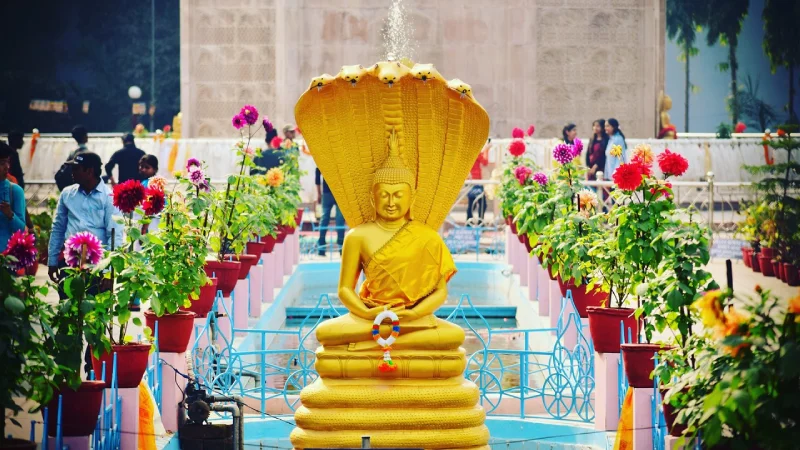
And the tree is still there. Not the same trunk — but a direct lineal descendant, cut and regrown and reseeded across twenty-five centuries, tended without a single break. A sapling of it was carried to Sri Lanka by Ashoka’s daughter Sanghamitta; when the Indian tree later died, a cutting was brought back from that Sri Lankan tree to restore it. The Dhamma has been repaying its debts to India for a very long time.
Isipatana: The Loneliest Walk in Buddhist History
What is easy to miss at Sarnath is the walk that preceded it. After his awakening the Buddha reportedly hesitated — what he had seen seemed too subtle to be spoken, and he considered saying nothing at all. Then he walked. Two hundred and fifty kilometres, on foot, alone, in the heat, to find five men who had walked out on him in disgust.
They saw him coming and agreed among themselves not to rise for him. By the time he reached them they were on their feet. That is the moment the Sangha becomes possible — not through a miracle but through a decision to teach anyway. Every monk in every robe in every country descends from that stubborn walk.
Stand at the Dhamek Stupa at dawn, before the buses, and the deer park is almost quiet enough to hear it. Devotees from Thailand, Myanmar, Sri Lanka and Vietnam chant the Dhammacakkappavattana Sutta here in four languages at once, and none of them needs a translation, because they all know it by heart. It is one of the few sounds on earth where you can hear the twenty-five centuries directly.
The Emperor Who Wept
Ashoka is remembered as a builder of stupas. He should be remembered as a man who publicly admitted he had done something unforgivable. After Kalinga he ordered his own remorse carved into rock, in the first person, for his subjects and his descendants to read forever. No emperor does this. Emperors carve victories.
From that grief came the great gift. Ashoka did not keep the Dhamma. He gave it away — to Lanka, to the Greek kingdoms, to the Golden Land across the eastern sea. Mahinda and Sanghamitta carried it as children carry a family lamp to a new house. The Theravada that a Thai grandmother recites at her home altar this evening reached Thailand along the road Ashoka opened. Devotion has a genealogy, and it runs through a king who could not live with what he had done.
When the Lamp Went Out
Then, slowly and then suddenly, the Dhamma left. The monasteries had grown magnificent and dependent, sustained by kings and merchant guilds rather than by ordinary households. Buddhism never took charge of the moments that bind a family to a religion — the naming of a child, the tying of a marriage, the lighting of a pyre. When patronage moved, there was nothing underneath to hold. The Bhakti saints sang, and the songs reached people the monasteries never had.
The end, when it came, was fire. Nalanda burned in the early 13th century; the tradition says its libraries smouldered for months. Monks were killed, and those who could ran north with manuscripts strapped to their backs, over the passes into Tibet and Nepal. They saved the texts. They could not save the place.
And then the silence. The Mahabodhi Temple sank under silt. Sarnath’s stupas were quarried for bricks to build a market town. Villagers grazed goats on Nalanda’s mounds without knowing what was underneath. For roughly seven hundred years, in the land where the Buddha walked, almost nobody knew where he had walked.
The Homecoming
The return began, as such things do, with one person refusing to accept a situation. In 1891 a Sri Lankan named Anagarika Dharmapala came to Bodh Gaya, saw the holiest site in Buddhism neglected and outside Buddhist care, and wept openly. Then he founded the Maha Bodhi Society and spent the rest of his life on the problem. Buddhists worship freely at the Mahabodhi today because a man from Colombo would not let it go.
Alongside him, scholars were doing quieter work. Alexander Cunningham walked Bihar and Uttar Pradesh holding the 7th-century travel diary of the Chinese monk Xuanzang, matching descriptions to mounds. A Chinese pilgrim’s notes, kept for a thousand years, gave India back its own map. Devotion had preserved what history had dropped.
The largest return came in 1956, at Nagpur, when Dr. B. R. Ambedkar took refuge in the Buddha along with roughly half a million people on a single afternoon — the largest religious conversion ever recorded. He died six weeks later. What he began did not.
And every year, the quietest return of all: pilgrims. Thai, Burmese, Sri Lankan, Bhutanese, Tibetan, Vietnamese, Korean. They built their monasteries at Bodh Gaya in their own architectures, side by side, so that the town now looks like a physical map of everywhere the Dhamma survived while India forgot. The children have come home to sit with the parent. There is nothing else in the world quite like it.
To walk this ground with people who understand its weight, the Varanasi-based Buddhist pilgrimage specialists at Prime Value Tours have accompanied devotees along this route for more than two decades.
What the Yatra Asks of You
A yatra is not a holiday with temples in it. The old texts are specific about why the Buddha named these four places — Lumbini, Bodh Gaya, Sarnath, Kushinagar. He said a devotee who visits them with a heart of faith, and who dies on that journey, is well-placed. The point is not the dying. The point is that the sites are meant to be met with samvega — that shock of urgency when the shortness of a life becomes suddenly, physically obvious.
How to Meet the Places
- At Bodh Gaya, sit. Do not photograph first. The tree has waited; you can wait twenty minutes.
- At Sarnath, arrive before sunrise. The chanting begins in the dark and the deer are still there.
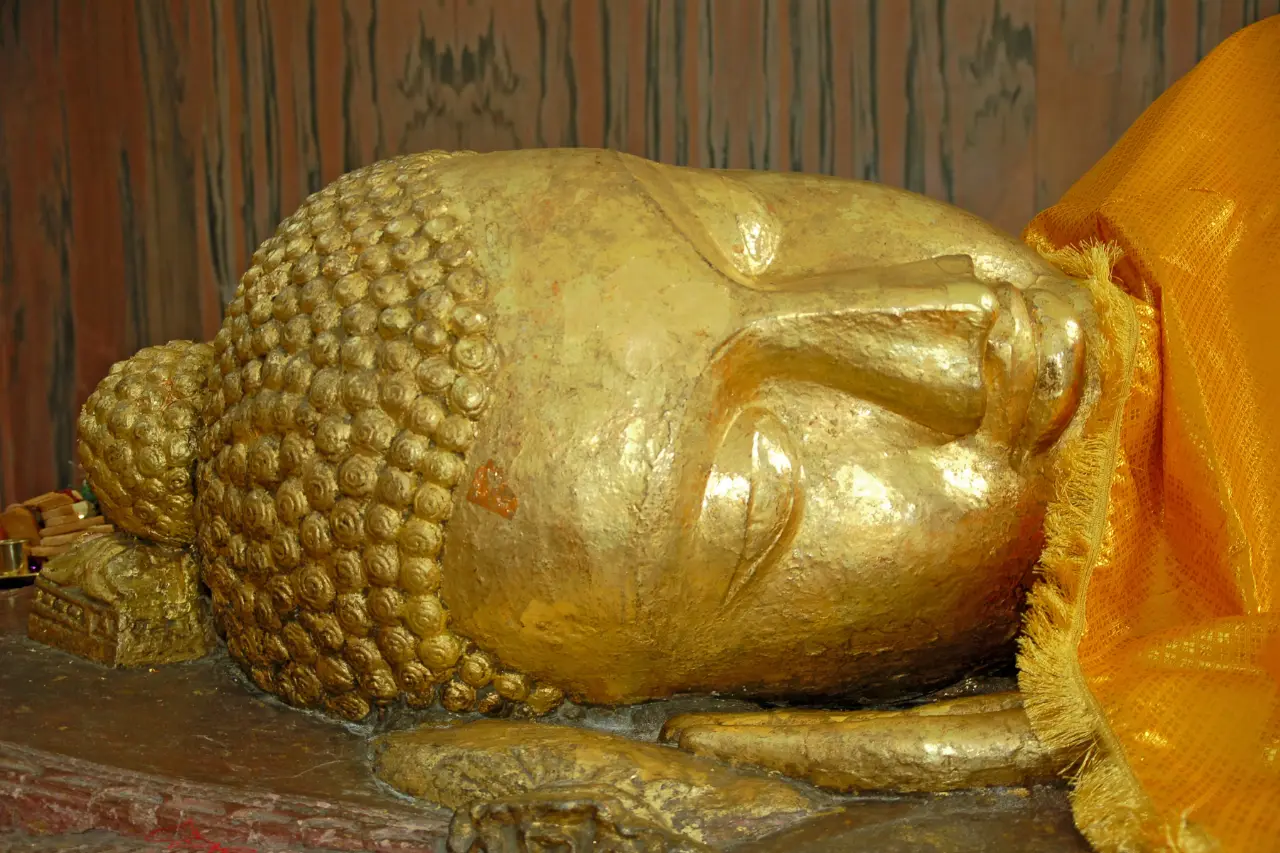
- At Kushinagar, look at the reclining Buddha’s face from three positions — it changes from smiling to sorrowing to still. It is meant to.
- At Nalanda, walk slowly and think about the books. That is what was lost there.
- Everywhere, give something. Merit-making is not a transaction; it is a rehearsal for non-attachment.
For pilgrims planning a complete circuit with guides who chant, expert Buddhist circuit operators in Varanasi can arrange the practical scaffolding around a journey that is not, finally, practical at all.
[Internal link: /bodh-gaya-mahabodhi-significance — anchor: “Bodh Gaya is not merely important”]
[Internal link: /sarnath-first-sermon — anchor: “Dhamek Stupa”]
[External link: Maha Bodhi Society of India — anchor: “Maha Bodhi Society”]
Questions Pilgrims Ask
What is the spiritual significance of a Buddha yatra?
The Buddha named four places worth seeing for a devotee of faith — his birth, awakening, first teaching and passing. The purpose is samvega: the urgency that arises when impermanence stops being a concept and becomes something you are standing inside. The yatra is a method, not a sightseeing list.
Why did the Dhamma disappear from India for so long?
Buddhism depended on royal and merchant patronage and never rooted itself in household rituals of birth, marriage and death. When the patrons turned away and the monastic universities were destroyed in the 13th century, there was no village-level foundation left to regrow from. The teaching survived abroad, not at home.
Is the Bodhi tree at Bodh Gaya the original tree?
Not the original trunk, but a direct descendant in unbroken lineage. When the Indian tree died, it was restored from a cutting of the Sri Lankan tree at Anuradhapura — itself grown from a sapling Sanghamitta carried from Bodh Gaya in Ashoka’s time. The lineage returned the gift.
Can Indian devotees make the yatra affordably?
Yes. The core sites of Bodh Gaya, Sarnath, Rajgir and Nalanda are all reachable by Indian rail, and dharamshalas and monastery guest houses at Bodh Gaya offer simple accommodation. A group booking through an established operator usually costs less per person than travelling alone.
Begin Your Yatra
The Dhamma came back to India carried by people who refused to let it stay lost. Joining that return is as simple as arriving. Prime Value Tours Pvt. Ltd., based in Varanasi within reach of Sarnath itself, has guided Buddhist pilgrims for over twenty-five years — with dhamma-literate, Thai-speaking guides who know when to explain and when to let a place speak.
Plan your yatra with Prime Value Tours — write to info@primevaluetours.com or call +91-9794122849.
Prime Value Tours Pvt. Ltd.
GST: 09AZPPS0293R1Z7 | PAN: AZPPS0293R
E8-Shanti Vihar, Jail Road, Shivpur, Varanasi – 221003, Uttar Pradesh, India
+91-9794122849 | info@primevaluetours.com | primevaluetours.com