
Buddhist Circuit Tour Itinerary and Cost: A Practical Planning Guide for 2026-27
Most Buddhist circuit itineraries fall apart at the same place: the map. On paper, Bodh Gaya to Varanasi looks like a short hop. On the ground it is a six to seven hour drive on roads shared with tractors, buffalo carts and overloaded trucks. Plan by distance alone and you will build a schedule that arrives everywhere after dark. This guide works through the circuit the way a tour manager does — driving times, sensible night halts, the border formalities at Sunauli, seasonal considerations and the cost variables that actually move a quotation. Whether you intend to book through an operator or attempt the route independently, these are the numbers you need before deciding anything else.
The Geography, Briefly
The circuit spans two countries and four Indian states. Bodh Gaya, Rajgir, Nalanda and Vaishali sit in Bihar. Varanasi, Sarnath, Kushinagar, Sravasti and Sankisa lie in Uttar Pradesh. Lumbini is across the Nepal border in Rupandehi district. Air access is through Gaya, Varanasi, Lucknow, Kushinagar or Delhi, and the choice of entry and exit airports is the single largest determinant of how efficient your routing will be. A full description of each site and its place in the Buddha’s life is set out in this complete guide to the eight great holy places.
Realistic Driving Times Between Stops
Treat these as planning figures for a coach, inclusive of a comfort stop. They are conservative on purpose, because a schedule built on optimistic timings collapses on day two.
- Gaya Airport to Bodh Gaya: about 30 minutes
- Bodh Gaya to Rajgir: around 3 hours; Rajgir to Nalanda a further 30 minutes
- Bodh Gaya to Varanasi: 6 to 7 hours
- Varanasi to Sarnath: 30 to 40 minutes
- Varanasi to Kushinagar: 6 to 7 hours
- Kushinagar to Lumbini, including border formalities: 4 to 5 hours
- Lumbini to Sravasti: 6 to 7 hours
- Sravasti to Lucknow: 4 to 5 hours
- Patna to Vaishali: about 2 hours
Two rules follow from this table. Never schedule two long driving legs on consecutive days for a group that includes elderly pilgrims. And never plan an arrival after dark at a site you intend to visit the same evening — highway driving after sunset in this region is best avoided entirely.
A Workable Ten-Day Routing
The sequence below reflects how the circuit is normally run when the group flies into Gaya and out of Lucknow or Delhi. It avoids backtracking, keeps the two heaviest driving days apart and gives Bodh Gaya the time it deserves.
- Day 1: Arrive Gaya, transfer to Bodh Gaya, evening at the Mahabodhi Temple
- Day 2: Full day Bodh Gaya — Mahabodhi Temple, Bodhi Tree, Sujata village, Dungeshwari caves, international monasteries
- Day 3: Bodh Gaya to Rajgir and Nalanda, night at Rajgir or Bodh Gaya
- Day 4: Drive to Patna via Vaishali, night at Patna
- Day 5: Patna to Varanasi, evening Ganga aarti
- Day 6: Sarnath — Dhamekh Stupa, museum, Mulagandhakuti Vihara
- Day 7: Varanasi to Kushinagar, Mahaparinirvana Temple and Ramabhar Stupa
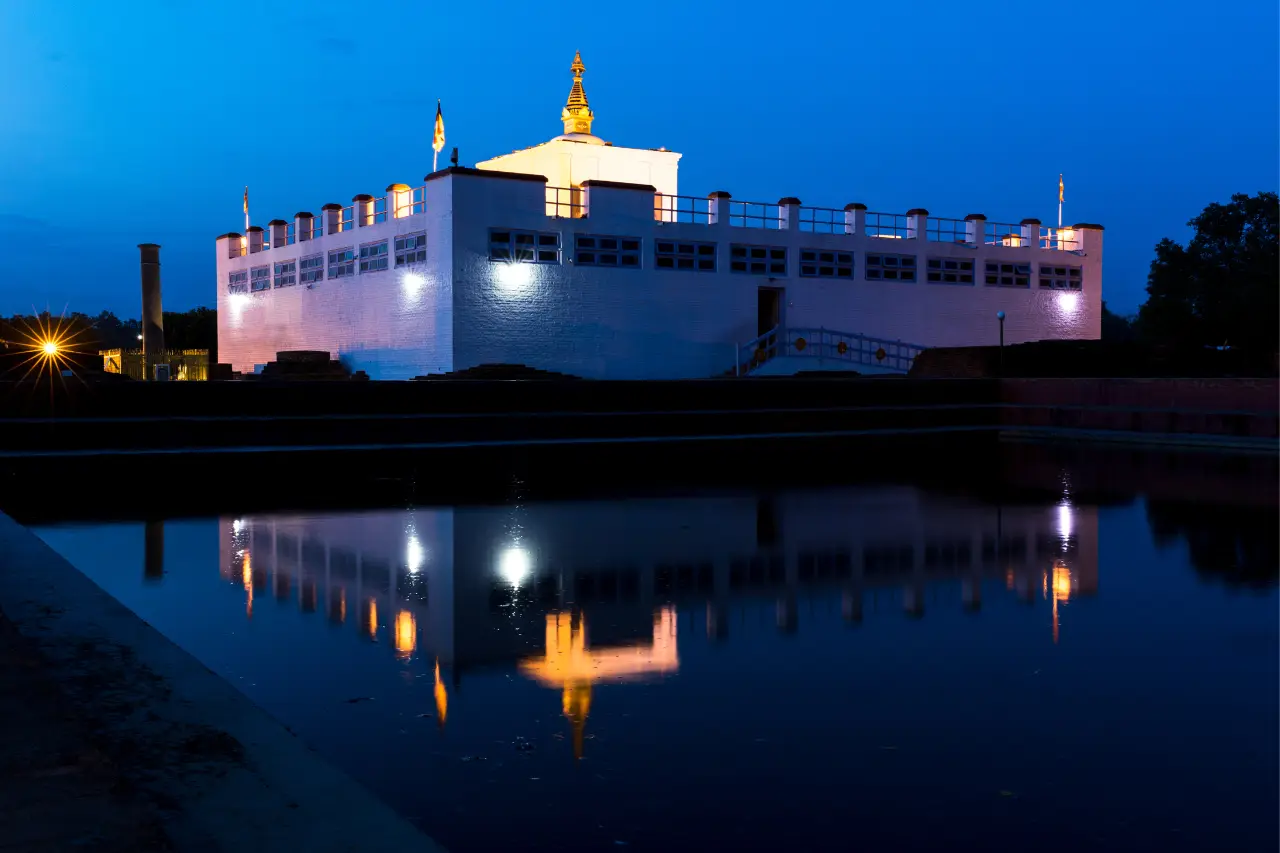
- Day 8: Cross to Lumbini, Maya Devi Temple and Ashoka Pillar
- Day 9: Lumbini to Sravasti, Jetavana Monastery
- Day 10: Sravasti to Lucknow, departure
Compressing this into seven days means dropping Rajgir, Nalanda and Vaishali and flying one internal sector. Extending it to fourteen usually means adding Sankisa, Agra or a Kathmandu extension after Lumbini.
Crossing Into Nepal at Sunauli
The Lumbini leg is where independent planners most often come unstuck, so it deserves detail. The crossing used by circuit traffic is Sunauli on the Indian side and Belahiya on the Nepal side. Key points:
- A Nepal visa is required. Most nationalities can obtain it on arrival at the land border, but processing a group of thirty takes time — budget two hours.
- A double-entry Indian visa is essential if you re-enter India after Lumbini, which almost every itinerary does. A single-entry visa will strand your group at the border.
- Indian coaches generally cannot operate freely inside Nepal, so a vehicle change at the border is normal. Confirm this is arranged rather than assumed.
- Carry passport photographs, and complete forms before reaching the counter.
- Cross in the morning. Afternoon crossings routinely lead to a night arrival at Lumbini.
What Actually Drives the Cost
Quotations for identical routes vary widely, and understanding why makes comparison possible.
Group Size
The largest single factor. Coach hire, guide fees, driver expenses and permits are per-vehicle costs shared across the party, so per-person rates fall steeply from 10 pilgrims to 25 to 40. Solo and small-group travellers pay a disproportionate share of fixed costs.
Accommodation Tier
Monastery and temple guesthouses along the route are the economical option and are widely used by Asian pilgrimage groups. Three-star hotels exist at every major stop; four-star and above is realistic at Bodh Gaya, Varanasi and Lucknow, thinner at Kushinagar and Sravasti.
Season and Booking Lead Time
September to March is the operating season. December and January are the peak, when Bodh Gaya hotel rates rise sharply and temple accommodation is fully committed months in advance. Booking a December group in mid-year rather than in October changes the quotation materially.
Guides and Language
A standard licensed guide is included in every quotation. A guide who speaks Thai, Sinhala, Japanese or Vietnamese and can explain the doctrinal significance of each site is a specialist resource and is priced accordingly.
Inclusions People Forget
Check whether the quotation includes monument entry fees, the Varanasi boat ride, Nepal border charges, porterage, driver and guide gratuities, and bottled water on the coach. These small items add up across ten days and are the usual source of disputes at settlement.
Choosing Your Season
October and November offer the most comfortable weather and moderate crowds. December and January bring cold mornings — under ten degrees at Sravasti and Kushinagar is common — and the year’s heaviest pilgrim traffic at Bodh Gaya. February and March are warm and pleasant, and the best value of the season. May brings Buddha Purnima and a remarkable atmosphere at Bodh Gaya and Sarnath, offset by serious heat. The monsoon months from late June to September see reduced road reliability in Bihar and are generally avoided for large coach groups.
Planning Questions Answered
What is the minimum number of days for the Buddhist circuit?
Seven days covers the four principal sites — Bodh Gaya, Sarnath, Kushinagar and Lumbini — with one internal flight or a long transfer. Anything shorter forces same-day visits with no time at Bodh Gaya, which defeats the purpose of the journey.
Which airport should I fly into?
Gaya is the most efficient arrival point when direct flights are available from Bangkok, Yangon or Colombo during the season. Varanasi and Delhi are the reliable year-round alternatives. Departing from Lucknow after Sravasti avoids a long return drive.
Is it possible to do the Buddhist circuit independently?
It is possible for experienced independent travellers, but the combination of road conditions, the Sunauli border formalities, limited accommodation at Sravasti and Kushinagar, and the absence of reliable public transport between sites makes hired transport with a driver the practical minimum.
How far in advance should a group book?
For December and January departures, six to nine months. For October, November, February and March, three to four months is usually sufficient. Temple accommodation and Bodh Gaya hotels are the constraints that bind first.
Get a Costed Itinerary
The routing and timings above are a working framework, not a quotation. Actual costing depends on your group size, arrival airport, accommodation preference and travel dates, and the only way to compare properly is against a written day-by-day programme. Prime Value Tours Pvt. Ltd. is a Government of India-approved, IATO-member destination management company based at Varanasi that has operated this circuit since 1999, with offices at Bodh Gaya, Lucknow, Delhi and Agra. Send your dates and group size to receive a full Buddhist circuit tour itinerary with per-person costing, including border assistance and language guides.
References: Archaeological Survey of India and the UNESCO World Heritage listing for the Mahabodhi Temple Complex.